


Malaga’s neighborhoods reveal a city much more diverse than it might seem from the historic center. Just a few minutes from the most monumental streets, areas with very distinct identities emerge: old industrial zones, fishing districts, spaces linked to urban art, and residential sectors where daily life still holds significant weight.
In this guide, we have selected six neighborhoods and areas that allow you to broaden your view of Malaga without straying too far from the city. Soho and Lagunillas offer two very different ways of understanding urban creativity; La Malagueta connects directly with the seafront; Pedregalejo and El Palo maintain a strong relationship with the sea; and Huelin combines neighborhood life, a promenade, and industrial memory.
The aim is not to replace the historic center, but to complement it. Exploring these neighborhoods helps to better understand how Malaga has grown, how its landscape changes from one area to another, and why much of its current character is found precisely outside the most common tourist routes.
Soho: Urban Art and City Transformation
Soho is one of the most visible examples of Malaga’s recent urban transformation. Located between the historic center, the port, and Alameda Principal, it evolved from a transit area into a space linked to urban art, contemporary culture, and new forms of public space use.
Much of this identity has been built around the MAUS project, Malaga Urban Art Soho, which transformed facades and party walls into canvases for large-format works by national and international artists. The result is a neighborhood where murals are part of the everyday landscape and where it’s worth walking without too rigid a route.
Beyond urban art, Soho’s appeal also lies in observing how this part of the city has changed. Once secondary streets now coexist with galleries, cultural spaces, small businesses, terraces, and residential buildings, in an area that functions as a transition between the city center and the port front.
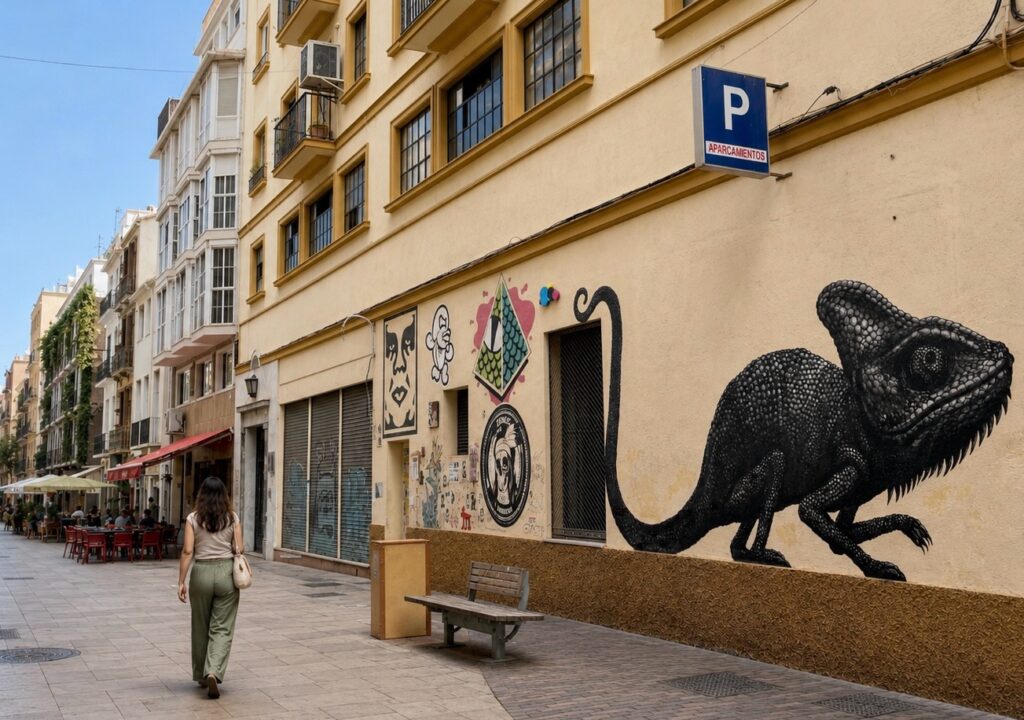
Its proximity to the historic center makes it very easy to incorporate into any walking tour of Malaga. It doesn’t require a long visit: just a few streets detour is enough to discover an atmosphere clearly different from that of the main monumental axes of the center.
Lagunillas: Creativity and Neighborhood Life Next to the Center
Lagunillas is a very short distance from Plaza de la Merced and the historic center, but just stepping into its streets reveals a different urban landscape. It is a traditional, small-scale neighborhood with a predominantly residential character, featuring an irregular street layout that retains its own identity within central Malaga.
In recent years, urban art has become one of its most visible features. Murals, intervened facades, and painted commercial shutters appear among homes and small businesses, often linked to artists and figures associated with the neighborhood itself. There isn’t an organized route here like in Soho: part of the interest lies precisely in discovering these interventions as you walk.
Lagunillas also allows one to observe a Malaga in transformation. The neighborhood has been the subject of various municipal urban regeneration projects, while maintaining a mix of long-term residents, new inhabitants, local businesses, and cultural spaces. This coexistence makes its image less uniform than that of other more touristy areas.
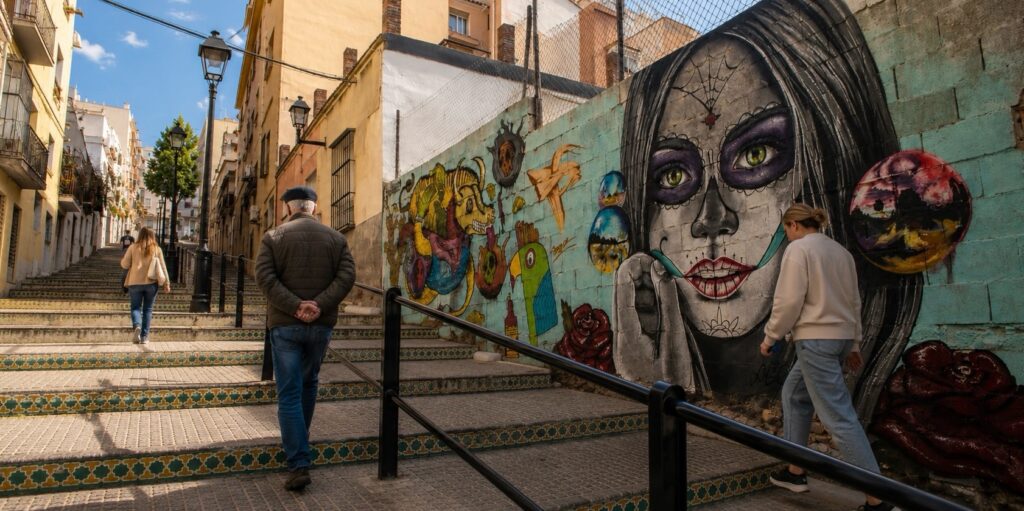
Due to its proximity to the historic center, it’s easy to incorporate it into a walk around Plaza de la Merced and then continue towards the Victoria area. Rather than looking for a specific monument, it’s worth exploring it calmly and paying attention to its streets, its murals, and the daily life that still unfolds around them.
La Malagueta: Experiencing Malaga by the Sea
La Malagueta is one of the neighborhoods where the relationship between Malaga and the sea is best understood. Located next to the port and a few minutes from the historic center, it combines residential character, a promenade, an urban beach, and some of the most recognizable spaces on the city’s coastline.
Although for many visitors the name is directly identified with the beach, La Malagueta is also a consolidated neighborhood, marked by large residential buildings erected especially from the second half of the 20th century. Its position, between the port, Malaga Park, and the Mediterranean, makes it a very natural transition between the urban center and the eastern part of the city.
The La Malagueta beach stretches approximately 1.2 kilometers and features a promenade, services, restaurants, and spaces for sports activities. Its main attraction lies precisely in the ease of combining a visit to the center with a walk by the sea without having to leave the city.
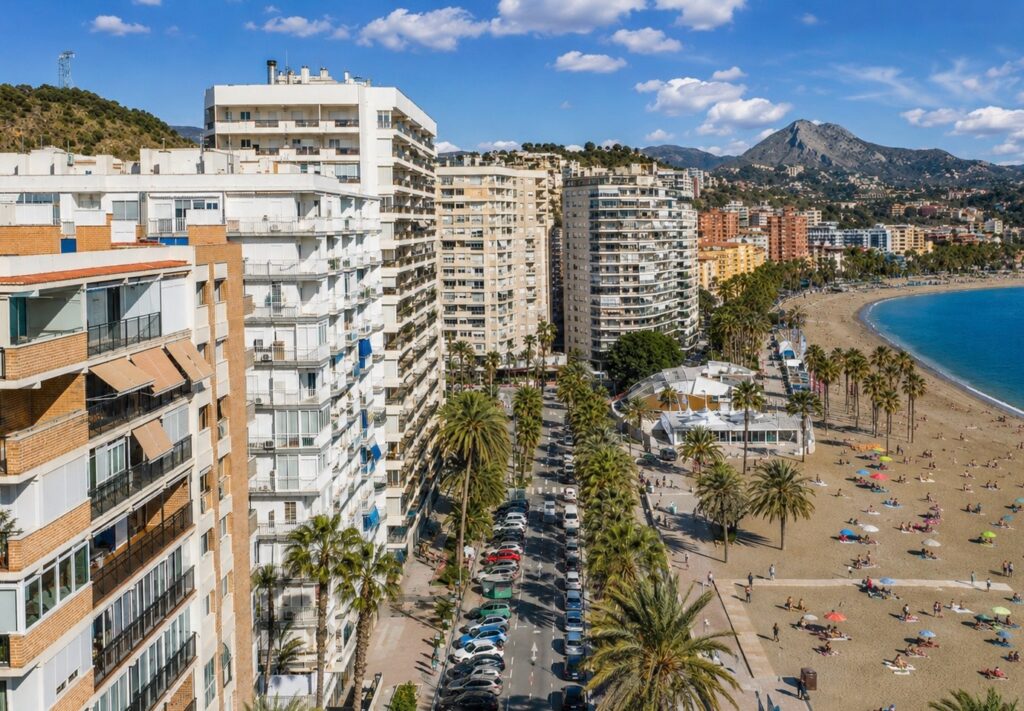
More than just visiting for a few hours on the beach, it’s worth walking along the promenade and observing how the urban landscape changes as you move towards La Caleta and the eastern neighborhoods. From here, a coastal axis also begins, continuing towards Pedregalejo and El Palo, the next two neighborhoods in this guide.
Pedregalejo: Fishing Houses and Promenade Facing the Mediterranean
Pedregalejo preserves one of the most recognizable landscapes of maritime Malaga. Located to the east of the city, it combines a promenade along the Mediterranean, small beaches separated by breakwaters, low-rise houses, and a long tradition linked to fishing.
The City Council identifies it as one of Malaga’s oldest and most traditional fishing neighborhoods. Its relationship with the sea remains one of the elements that best explain its identity, although today it coexists with a residential atmosphere, numerous restaurants, and a constant presence of visitors and residents walking along the promenade.
One of its most characteristic features is precisely this promenade, considered the oldest in the city. Along the route, terraces and restaurants specializing in fish and seafood abound, while the small coves and the proximity of homes to the coast maintain a scale very different from that of large urban beaches.
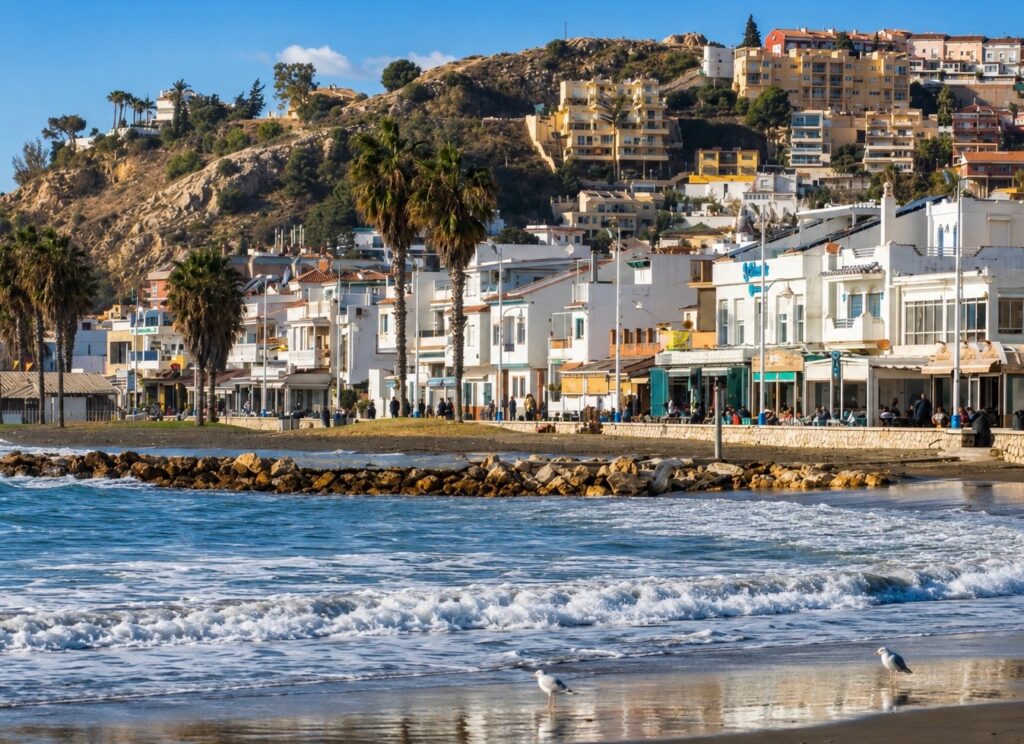
Pedregalejo is especially worthwhile for its combination of neighborhood, promenade, and sea. There’s no need to plan it as a visit with mandatory stops: the most interesting thing is to explore it unhurriedly, stop by the beach, and then continue towards El Palo, where the connection to the fishing tradition is still very visible.
El Palo: Neighborhood Identity and Tradition by the Beach
El Palo maintains a very distinct neighborhood identity and a relationship with the sea that is still visible in its daily landscape. Located east of Pedregalejo, it combines a promenade, beaches, homes, local commerce, and a fishing tradition that is still part of the area’s life.
The presence of boats on the beach recalls this link to fishing and differentiates this part of the coast from other areas more transformed by tourism. Although El Palo is now fully integrated into the city, it retains its own character and a scale closer to that of a neighborhood than an independent tourist destination.
Walking along its promenade allows you to observe this mix of residential uses, commercial activity, beach, and restaurants. It is an especially pleasant area to walk without a fixed itinerary, stop by the sea, and continue discovering the continuity of Malaga’s eastern coast.
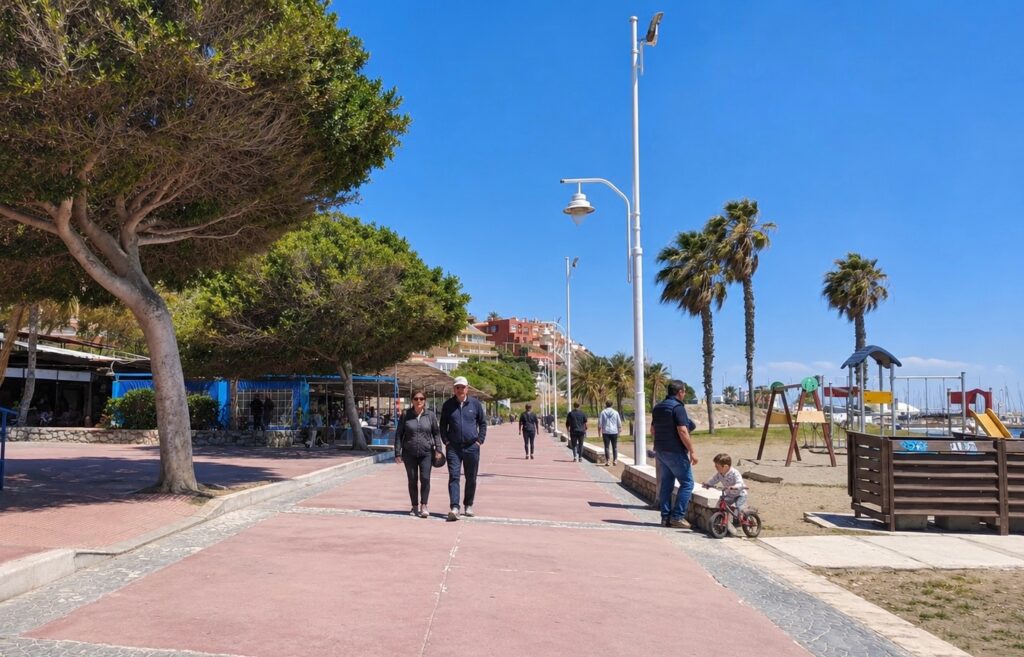
Pedregalejo and El Palo can be perfectly visited on the same route, but it’s worth treating them as two different spaces. The first presents an image closely linked to its promenade and old houses by the sea; El Palo retains a more distinct neighborhood feel and a still recognizable fishing tradition.
Huelin: Industrial Memory and Local Life West of Malaga
Huelin offers a very different image of Malaga from the historic center and the eastern fishing neighborhoods. Located to the west of the city, it is a residential neighborhood with a strong identity of its own, historically linked to Malaga’s industrial growth during the 19th century.
Its origin is directly related to that industrial expansion. The neighborhood took shape as a working-class settlement around factories and productive activities, becoming one of the city’s first experiences of workers’ housing. Over time, the old industrial facilities disappeared, but that era still forms part of the memory and landscape of the area.
Today, Huelin combines residential streets, local shops, its municipal market, green areas, and the proximity of the promenade. Towards Misericordia beach, old industrial chimneys can still be seen, surviving as vestiges of that industrial Malaga and creating a very characteristic landscape by the Mediterranean.
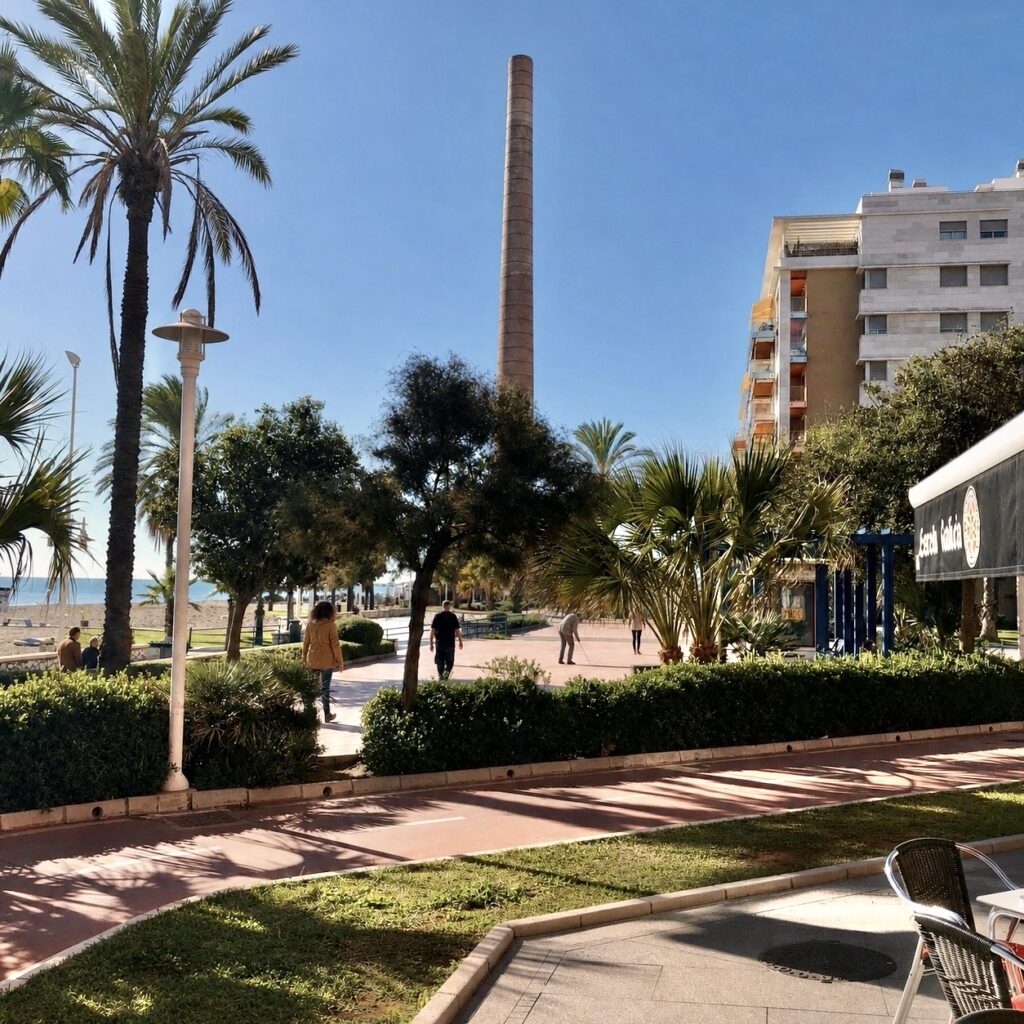
Exploring Huelin allows you to discover a part of the city less present in tourist guides and better understand how Malaga expanded westward. It is also a good area to combine a walk through the neighborhood with Huelin Park, the market, and the seafront, especially if you want to discover a more everyday Malaga.
How to Explore Malaga’s Neighborhoods from the Center
One of Malaga’s advantages is that several of these neighborhoods can be easily integrated into walking tours or combined with public transport. Soho and Lagunillas are very close to the historic center and can be visited without needing to arrange specific travel.
To better locate these neighborhoods and other points of interest in the city, you can consult our Malaga map, where you will find a selection of places of interest in the center and its surroundings, as well as the location of Abele 45 Old Town.
La Malagueta is also a comfortable distance from the center and serves as a starting point to continue along the coast towards Pedregalejo and El Palo. In this case, the most practical option is to combine walking and public transport, especially if you want to explore the entire eastern area at leisure.
Huelin is in the opposite direction, to the west of the city, and can be visited along with Huelin Park, the market, and the promenade. It is a good option for those who already know the center and want to discover a more residential Malaga, less influenced by the main tourist circuits.
If you are staying at Abele 45 Old Town, Soho, Lagunillas, and La Malagueta are especially easy to incorporate into your city walks. To organize the rest of your stay, you can also consult our guide to 48 hours in Malaga and the article on Malaga markets, which includes Huelin and other neighborhoods with strong local life.
Check availability at Abele 45 Old Town
